




 Watching my daughter at her swim class today, I realized how learning to swim and learning to write are similar. When learning to swim, support is important. The same holds true for learning to write.
Kids first jumping into the water need flotation devices, which range from life jackets to noodles. My favorite—which my daughter used in her swim class—is the “bubbles.” This is a belt with up to 4 buoyant squares on it. The belt doesn’t restrict motion and it is adjustable—as you gain proficiency you drop to 3 bubbles, then 2, then 1, then none.
Writers first jumping into writing are no different. We need help to stay afloat. Our flotation devices are workshops, classes, conferences, mentors, and craft books. As we get better, we need fewer of these, although with writing the learning never stops—thus our career-long need for beta-readers, critique groups, and editors.

Lifeguards in the tower (Photo credit: Wikipedia)
Another vital element when learning to swim is lifeguards. Lifeguards see when you’re in trouble and rescue you. They can see what you’re doing wrong and save you from ever getting in trouble in the first place.
Writing communities are both flotation devices and lifeguards. When we run aground on hazards like writer’s block, deadline desperation, marketing overload, or mid-novel burnout, other writers are there to tell us we are not alone. They’ve been through the fire, too, and often have tips to share.
And when you are finally published and out there in the wide world, this network of writer-lifeguards has your back. They’ll help guide you through the marketing morass, show up at your book events, and spread the word on social media. Writer friends will comfort us during the bad and celebrate with us during the good.
Writing can be lonely—but it doesn’t have to be. Find yourself a good, supportive writing community, either in person or online. Your family undoubtedly loves you a lot, but there are certain things only another writer truly understand. If you say sadly, “Saggy middle” to your family, they will poke your belly and give you diet tips. If you say “Saggy middle” to your writer friends, they will tear at their own hair and shout, “I KNOW!”
The journey is certainly easier and more pleasant if we surround ourselves with people who are willing to support each other, give generously of time and advice, and fill this whole adventure with laughter. Find people who lift you up, not tear you down. I’ve been lucky—and I hope you are, too.
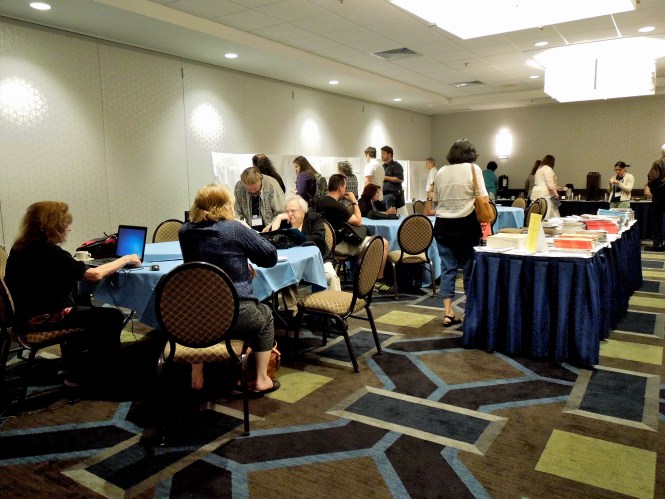
Conferee lounge at the Philadelphia Writers’ Conference.
(Photo by J. Thomas Ross)
Can you suggest places writers can find supportive writer communities—online or in person? Do you have stories about how being a part of a community has helped your career?














The Black Belt Writer
Writing can be terribly subjective. One reader loves your every word; another reader wants to use your book as kindling. Sometimes I wish writing came with an objective measurement to see how you’re advancing—like Karate.
My daughter took up Karate this summer, and I’ve found myself having conversations with her that I have with other writers. Most recently, we had the “don’t compare yourself to others, just to your own progress” talk. She was worried that she would always be a white belt, because others were better and farther advanced than she.
We writers go through similar feelings. Heck, it’s hard not to compare yourself with other writers, especially when these are other writers that you know personally. It’s easy to think that you’re not succeeding, that you’re never going to get “there” (wherever “there” is for you). That you will be a white belt forever. So the only way not to drive yourself crazy is to stop comparing yourself to other people, and mark your progress against your own past. Is this writing better than what I wrote last week? Last month? Last year?
But how do you mark your career progress in this subjective field? In Karate, moving up to the next belt has two components: physical and mental. It’s not enough to learn the techniques of the moves—you also have to display the right attitude, with discipline, focus, and respect being high on the list.
The same is true of writing. We learn the techniques (save the cat, hero’s journey, kill your darlings, etc.) and work to improve them. We practice and practice until each clumsy new technique becomes a subconscious movement in our work. But that’s not enough to climb the belt ladder. We need to have the right attitude, too. We won’t get far without discipline and focus to get work done and respect for the people we work with—most of all, for our future readers.
So we all start out as white belt writers, and we work and work and finally we feel like we’ve got the craft under control and the attitude is right where it should be. So we’re black belts, right?
Not so much. I’m thinking maybe purple belts—about half way to black.
Because now all the publishing stuff enters into the equation. Now we have a whole new set of techniques to learn (many of them at odds with our temperaments) and a whole new attitude to adjust.
So we dive into marketing and publicity and meeting the public and social media and, oh, yeah, we’re still supposed to be writing somehow, and didn’t I leave my family laying around here somewhere? But slowly we learn the ropes of our new existence, and we adjust our attitude to the professionalism needed to work with agents, publishers, movie/TV producers, other authors, booksellers, and, of course, our readers.
Okay, we’ve done that. So now we’re black belt? Maybe. I’ll leave that up to you. I might consider a true black belt writer to be one who not only lives on their writing but is able to write what they truly want to write. You might choose to award a black belt at publication, or a certain number of books sold, or even when you have written a book that finally matches the vision in your head whether it gets published or not. The definition of success, like so much in the writing world, is personal.
And that is as it should be.
Do you ever wish there was a visible way to tell where you were in your writing career? How do you measure your success?