

Time is Relative

Don’t panic! I’m not going to attempt to explain Einstein’s theory of relativity and how it applies to time. But I think we all know that time, or at least our perception of time, can vary a great deal. To a child, a week seems like a year, while to an adult a year passes in the blink of an eye. An hour at work can feel like a day, while an hour spent doing something you love seems like a minute. So we all understand intuitively what we mean when we say that time is relative, even if we can’t explain the physics of time.

I mentioned in an earlier post that I now have about 10 hours a week child-free. The first week I sort of loafed through those 10 hours, enjoying them and doing what I wanted. But even by the end of the first week, a pattern had started to form.

I write in the library when my daughter is at school. The problem is that the library doesn’t open until about an hour after I drop her off most days (Monday is the exception–they open early that day). So I’ve gotten into the habit, now that it’s cooler and I won’t sweat or stink, of walking several thousand steps around the grounds while waiting for them to open. I use this time to think about the things I am going to do once I sit down to work. For instance, much of this blog post was written in my head as I walked.

Then I sit in my car or at the tables in front of the library (depending on weather) and fire up my laptop. My laptop battery won’t last the full hour, so it’s just as well I walk for some of the time. Exercise is important, too! Then I work on whatever I need to until the library opens, when I move the writing party inside and can plug in.

My problem has been in planning what to do each day. I always do have a plan of action, but it always turns out to be woefully inadequate to the amount of time available–I often run out of planned things to do long before the two hours is up. Because, see, time is relative–a child-free hour is massively more productive than a child-full hour. But after a summer of writing catch-as-catch-can, it is hard to remember just how much work can be done when you’re not constantly being interrupted!

Almost 4 times as much work.

That’s a lot.

I need to get better at planning what I’m going to work on, because there is no doubt that when I have a focus or a path firmly in mind when I sit down, I write faster and better and more than if I sit and stare and wonder what to do next. This goes for fiction as well as non-fiction. If I know what chapters I plan to work on, I can really think them through the night before, the morning of, and while I’m walking, so I can sit down and really write, instead of thinking. Thus getting the most out of my concentrated writing time.

So, to be at my most productive, I have to realign my brain to Non-Parental Standard Time when I plan my child-free writing hours. And then switch back to Parental Sanity Savings Time once I pick up Preschooler.

I sure hope I can avoid the jet lag.

What makes time fly (or drag) for you?
GoosesQuill FB

Frittering Time

My daughter went back to school this week. Yay! I have magically acquired 10 child-free hours a week in which to work. It’s like Christmas in September.

It’s not all fun and games, however–the new schedule requires adjustment. For one thing, we need to get up at 7 AM–not terribly early by most standards, but my body does not like it. I have always noticed a huge difference in how I feel just getting up at 8 versus 7. And I mean with the same number of hours of sleep. For example, I am much more awake with 6 hours of sleep (my usual) getting up at 8 than I am with 6 hours and getting up at 7. That’s just the way I am wired.

How I wake up is another factor. I am either A) jerked out of a deep sleep by my alarm, which I swear erodes years off my life, or B) awake around 6 AM and then never go back to sleep because I know I have to get up in an hour. Neither is ideal, and no doubt contributes to my tiredness during the day.

But the main adjustment I need to make is that I actually have more work time. So I need to actually WORK during that time. This first week, with this abundance of time, I find myself frittering my work time. I think, “Oh, I have plenty of time.” and then spend just a few more minutes online, or playing an extra game of Solitaire, or reading just one more chapter, or diverting time to another hobby (or sometimes even cleaning the house). And suddenly I find I have gotten no more work done with this extra time available than when I did not have it.

Now, we all need to have some leisure time to recharge, so spending a little of this extra time reading or on a hobby (or–gasp–sleeping!) can in the long run be a productive use of time, in that it keeps me from burning out. But to reach the goals I have set for myself this year, I need to buckle down and use 80% of this “found time” to forward my work. And I will.

Any time my work time fluctuates wildly, either getting more or getting less, it takes a week or so to adjust my mindset to match. So for this week, I am letting myself play a little, as long as my must-do work gets done. Next week the focus will return, and hopefully I will have adjusted to the sleep schedule as well.

10 child-free hours a week. You can conquer the world with that much free time.

How about you? Do you have trouble being productive when you suddenly have a great deal of free time?

GoosesQuill FB

A New Journey

I wrote several weeks ago about a new novel that came to life in my head—the first new novel in more than 3 years. Well, this week I put pen to paper on this new Work In Progress (WIP). Just a few paragraphs, nothing mind-blowing. But it felt really, really good to start on a new journey.

I’m trying something a little different with my process this time: I’m trying to think more before I write. Not necessarily plot more, but spend more time in the pre-writing stage, getting to know my characters, their motivations, their world. To have more of the subtext in place in my head before I write.

My main reason for this is because I want to try to get my characters stronger earlier in the writing process. My biggest struggle of late is to make my characters “real” to the reader. It takes a great deal of revision to layer and nuance characters who were flat in the beginning, and even then it doesn’t always work. Some things are easier if you get them on a good footing from the beginning.

Another reason for the pre-writing is so I can hopefully cut down on the number of revisions I go through before my story is ready to go out. I love the revision process, but the more depth and detail and structure I can have in place in the first draft, the less revising it will take to get it in there later. My first drafts tend to be quite underwritten. While I think that will not change too much, I am hopeful that more of what is there will be valuable, and less will be dross to be thrown away completely.

As I said in the beginning, this does not mean I intend to plot every scene, as some people do. I cannot work that way. However, I do intend to plot the high points of the action and the character arcs—from there I can play connect-the-dots as I write, and let the story figure out how to get from point A to point B. My intention is to improve my writing speed by having some idea where I am going as I write, rather than simply meandering all over the place. Some meandering is necessary to my writing, but a little more control will not hurt.

So my new journey with my new WIP has begun, and I am trying a few different approaches to try and hone my process. A long road remains ahead—and what a wonderful adventure it will be!

GoosesQuill FB

Renaissance: Reviving my Muse

I’ve written before about the creative slump I’ve been in since my child was born 3 years ago. All the long-form works I’ve put out since then have been projects I began before her birth. In most cases, the entire first draft had been done prior to her arrival.

Truthfully, the complete lack of creative drive and new ideas scared me. It felt like something inside me had died, and that’s a pretty permanent feeling. I had this secret fear that I would never have another idea for any other novel for the rest of my life. But I slogged along, hoping that somehow the spark would rekindle.

I did all I could to stoke the fire. I took workshops, I went to conferences, I blogged, I read, I began writing short stories, I hung out with really cool fellow writers. I kept writing—even if it wasn’t very good. Most of the time I felt like I was getting nowhere really, really fast.

But then a strange thing happened. I went to the 2013 Philadelphia Writer’s Conference—and came away with stirrings I hadn’t felt in close to 3 years. Whispers of the Muse. Sparks. Nothing concrete, but a sign that all hope was not lost.

The fire burst forth in full conflagration just a few weeks ago. I had a long day of driving ahead of me. Usually, I love this alone time and don’t even turn on the radio. With a curious 3-year-old around, quiet is something I rarely have, so I find solo drives soothing. But with over 4 hours on the road, I knew I wanted some music this time.

So I stocked the CD player with songs I hadn’t listened to in years—songs that have a strong writing connotation for me. Songs that evoke particular stories I’ve written, characters I’ve created, and worlds I’ve imagined. Songs that take me back to a time long before marriage and child, and even before adulthood. A time when creativity geysered out of my brain.

And a new novel was born.

By the time I got home, the characters, the world, the backstory—all of it—glowed there in my mind, longing to break free. I jotted notes and reveled in the whirling dance. Although I can’t jump in with both feet right now (trying to finish another project on a deadline), my shiny new object is waiting for me like a reward. Just knowing it is there makes me giddy.

This new novel has a long way to go before it becomes anything, but I have not been in this stage of creation for so long that I had forgotten the elation of it. While I am certain the sleep deprivation and motherhood will make my creative process less than smooth, I am once more standing at the start of a new adventure.

And it feels amazing.

Have you ever lost your writing mojo? How did you get it back?

GoosesQuill FB

The End of an Era: When Writing Mentors Move On

You know that moment in Star Wars where Obi-Wan Kenobi gets killed and you freak out because Luke’s just lost his mentor and he still is nowhere near where he needs to be, training-wise? That’s kind of where I am right now.

In 2005, I met Jonathan Maberry, who had joined the now-closed Writer’s Room in Doylestown. From that moment on, he has built a wonderful society of writers in the Greater Philadelphia area. Now there is a thriving community, helmed by the Liars Club, that has workshops and networking meetings and just has a generally good time.

I have been a part of an ongoing workshop of Jonathan’s since 2006. Originally called Revise & Sell, it is now known as the Advanced Novel workshop. Basically, all of us in the workshop have novels in some stage of development (but beyond first draft) and are trying to get published. I was one of the original workshop members. Over the years, people have come and gone, but a core group has stayed rock-solid and bonded together. We critique each other’s work when asked. We offer a shoulder to cry on when needed. We discuss problems, both craft and business, that are standing in our way. A group of us formed The Author Chronicles group blog about 3 years ago. Several of us have had short stories published, and one member, Tiffany Schmidt, is now a published novelist with her second book coming out in February!

So when Jonathan told us he was moving to San Diego later this year, it was a bit wrenching—one of the main pillars of my writing life was disappearing. We had what is likely to be our last in-person class last week, which was a weird feeling of endings and beginnings all mixed into one.

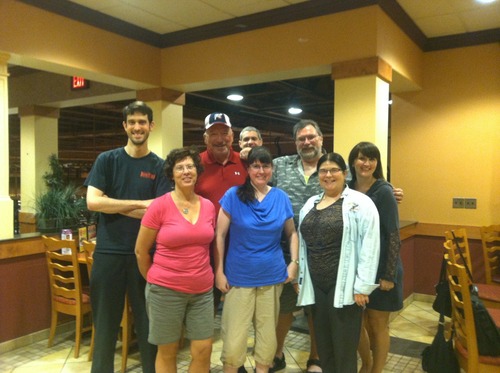
Last R&S Class

Last in-person class. Photo courtesy of Tiffany Schmidt


But the thing is, just like Luke Skywalker, we aren’t really losing Jonathan at all. Technology today has made it possible for us to continue this workshop virtually, through Skype. I am looking forward to keeping up the forward momentum we have built together. Although conversing with a flickering, pixelated mentor is a little too sci-fi even for me! But maybe we’ll get lucky and the Force will be with all of us.

I wish Jonathan all the best in his new adventures out in California. The man is a force of nature; I have no doubt he will do well. And I’m glad that technology will allow us to stay in touch as a class, because I get quite an energy boost from our meetings—and I think there are good things ahead for all of us. I want to be there to cheer the others on and celebrate when they get their big break. We’ve all done the hard work—but it’s with Jonathan’s guidance that we’ve come as far as we have.

So, thank you, Jonathan. It’s the end of an era—but the beginning of a new one. I can’t wait to see what new opportunities the new era brings.

Have you ever had a writing mentor?

GoosesQuill FB

Newbery Picking

I decided as part of my continuing education in YA & children’s literature to read all the Newbery Award winners. The award has been given since 1922, so you can image the breadth of genre and writing styles encompassed by this list.

I’m nowhere near done the list, but I have been enjoying the adventure. I’m reading books I might not otherwise have picked up, and I can say that I have not been disappointed in any of them so far.

While I am enjoying them as a reader, I am also noting craft as a writer. I am always trying to improve my writing, so looking at how the best of the best wrote is a good education.

So far, three things have jumped out at me:

1)     In the Chronicle of Prydain series, Lloyd Alexander wowed me with his ability to have each character sound so unique that I didn’t need to read the dialogue tags to know who was speaking. This is something I struggle with—making them sound different and making the difference sound natural. I have not been captivated by a series so completely in a long time, and Alexander’s characterizations were a large part of my enthrallment.

2)     In Out of the Dust, Karen Hesse’s description of Dust Bowl Oklahoma blew me away. I could feel the dust smothering me, gritty in my eyes, mixed in my food. When I looked up from the book and out the window, the green grass and trees shocked me—I had almost expected dunes of dust. She wrote the novel in verse, so it is hardly surprising her descriptions are poetic, but I don’t think I have ever felt a novel so physically as this one. I have improved a lot in my description, but Hesse has set the new goalposts very high.

3)     Finally, all of the books could tell a story well. Obviously. But to read book after book where the structure is so solid and complete is a great way to “feel” structure. Some books had many action scenes and a breath-taking pace. Others not much “happened,” and the pace was leisurely (but never plodding). But with every book I feel confident and sure as a reader, safe in a skilled author’s hands, trusting them to lead me to a satisfying ending. And they all have. I believe my story-telling ability is strong, and although in my early drafts the beginning and end don’t always connect cleanly in the middle, I get there by the time I’m through.

This is homework I enjoy doing, and I look forward to learning much more from the remainder of the list.

What books have you read that stand out for you as stellar examples of some part of our craft? (I’ll add them to my reading list!)

GoosesQuill FB

What Message Are You Sending in Your Writing?

I have a three-year-old daughter, and that has made me very aware of the messages we send our girls in literature, movies, magazines, etc. Our culture sends messages that are at best annoying and at worst destructive, not just to girls but to boys as well.

So I read Karen Jensen’s blog post about messages we are sending our kids in YA with great interest. She noticed a trend in YA where 2 things happen: 1) a girl tells a boy firmly and repeatedly that she does NOT want a relationship (not sex, just a relationship) yet he does not take no for an answer and she ends up capitulating, and 2) in the final climax, it is the boy that saves the girl—the girl does not save herself.

I decided to look at my own YA work-in-progress (WIP) to see if I fell into those traps.

First, did any of my male protagonists ignore my female heroine’s “No” to a relationship (thus reinforcing the “no doesn’t mean no” culture)? To my relief, this was not the case. There is a boy who pursues a friendship with my heroine, even though Polly is hard to get to know, but she clearly WANTS to be friends with him and she communicates that.

Whew. One down.

Second, does my male companion end up saving the female heroine? That one’s a little harder. In the end, Polly does end up physically saving HIM, so at first it seems like another win for me, but… There is a moment, a key moment, in the climax where Polly needs to have an insight in order to save the situation. And the key insight is made by…the male companion. But is this a problem?

Every heroine has their sidekicks. Buffy had her Scooby Gang, and Harry had Hermione and Ron. All the sidekicks chimed in with important information—often key information—at times. In the end, though, in that climactic moment, it was always Buffy or Harry who stepped up and put it all together to save the day.

So is mine a case of a sidekick bringing valuable info that the heroine then acts on? It could be interpreted that way. And none of my beta readers have flagged that moment as not working.

But.

I am going to change it anyway.

Why? Because I think it is important to Polly’s character that SHE be the one to have the insight. She needs to have the moment of understanding and then wrestle with the new knowledge herself. This revelation she has fundamentally changes her perception of herself and her relationship with the world. It will be much more powerful for HER to realize this than to have someone else tell her.

So I thank Karen for her article, because even though I got it about ¾ right in my WIP, this will enable me to get it right all the way. I try very hard to think outside the cultural messages we’re all immersed in all day, every day, but it seems even I fall back onto those messages unconsciously. That is why it is so important that as a writer of YA and middle grade I take a step back and objectively look at the subconscious messages my books are sending. Not that I want to moralize or lecture—far from it. I just want to show my readers what kids can be.

I want to show them that their greatest strength lies in being true to who they are.

What about you? Do you ever think consciously about what messages your writing sends? At what stage in the process do you think about it?

GoosesQuill FB

Why I do things the “right” way

When I first started doing genealogy, I had no idea how to properly cite my sources. So I did it any old way. Now, I do know how to do it right, and I am engaged in a time-consuming process of going back over my source citations and correcting them. Since I’ve been doing genealogy for about 20 years, that’s a lot of source citations!

So why am I bothering? What I have is adequate, in that a person looking at it will know where my information came from. For example, I had a lot of entries from the Philadelphia City Directories. I noted the year of each directory, but not the page number. Good enough, right? I mean, someone else could easily look up the page number if they wanted to. Yes, they could. But it’s not the proper way to cite something. So I spent several hours re-finding the pages and entering them into the database.

Why, when what I had was good enough? In this case, it is because I want people who find my tree online or who read my book to take my work seriously. I want them to have the confidence that my sources are correct, that I am not guessing or engaging in wishful thinking (often an issue with amateur genealogists).

The same goes for my fiction writing (and everything I do, really). I can get to “good enough” in most aspects of the craft very easily. But “good enough” is not good enough for me. This is different from perfectionism, which is never satisfied and will never let go of a project that isn’t “perfect.” I know perfection is impossible, but I want to give my best effort on all levels at all times. I want to put everything I have into a project—cross all my t’s, dot all my i’s. Even when I don’t HAVE to.

Why? Because I am serious about my craft, and I want it to show. So I take the time to do the extra round of editing, to do the search and find on the “to be” verbs and “ly” words. I take the time to storyboard the book several times during the process, to make sure it all fits together and that I am not forgetting something. I take the time (and money) to have a professional editor give me feedback to make it stronger.

We all have experienced times in our lives when other people gave half-hearted effort and yet still got ahead—they got a better grade than you, they got a promotion, etc. We all know that doing things “right” is not a guarantee of success, or even a guarantee of acknowledgement. Sometimes I think my life would be much easier if I could be the type of person who settles for “good enough.”

So why do I bother trying to do things “right”?

Because at the end of the day, the product I put out reflects on me. Whether it be a book, a short story, a batch of cookies, a video, it is a product I created. I want to be able to take pride in the work, no matter if it gets me accolades or book deals. I want to know in my heart that this particular piece of work was done as well as I could do it at that time. That it reflects the best of me at that moment.

I suppose this strong work ethic was instilled in me by my parents (for which I thank them). But I have internalized it because of the satisfaction it brings me. Knowing that what I put out there is the best I can do is a rewarding experience for me. Another way to think about it: Most of us don’t leave much behind when we leave this earth—I want whatever I leave behind to be the best of me.

What drives you to put so much effort into your work?

GoosesQuill FB

Contents and Endnotes and Index, Oh My!

I’m embarking on a new venture—non-fiction. It’s a whole new world.

As you may know, I am heavily into genealogy. Several years ago, I compiled all my data into a prose format to distribute to my father’s family (I’m still working on writing out my mother’s). Now, I have more information, and I am updating the book. But this time, I am working on it with an eye towards a wider audience.

Now, I know that genealogy books do not appeal to the general public. However, to that sleuth searching for their family, for that one missing link, a book about their line is pure gold. I cannot thank enough the people who have helped me on my quest, nor can I fully describe the joy of finding a treasure trove of well-documented information.

I want to give others that “family tree high.”

My intention is to fully source the book with endnotes and citations, so anyone reading the book will know the primary source of the information. Wherever possible, I will include pictures and scans of those sources. And I will put it online for as reasonable cost as I can so that others can access the information easily. I also intend to donate copies to local historical societies and/or libraries with genealogical collections. I want this information to be found.

But writing this book is much harder work than I thought.

Not the content itself—writing about each family lineage and couple is pretty easy, as it is chronological and all the information is right in front of me in my genealogical database. It’s the rest of the book that’s making me a little nuts. Like the Table of Contents. And Endnotes. And Index. Oh my.

My version of Word (2007) insists on creating my Table of Contents for me. Which would be very nice if I could figure out how to do that. It’s got something to do with “Styles,” but I have yet to get the details right. I need to sit down and figure it out because once I do, Word will supposedly update the Table of Contents as page numbers change. But so far it has been a headache and I long for the days of the old Word where I could do it myself without my computer freaking out and trying to think for me!

The Endnotes are fairly easy—soooo much easier than on a typewriter!—but I had forgotten what a pain it is to cite every fact on a page. Haven’t done that since my Master’s Degree ten years ago. However, citing everything has been a wonderful way of double-checking my sources within my own database and finding holes I still need documents to fill.

Then there’s the index. What a Herculean task! As far as I know, there is no shortcut to doing this in Word. I have to go through each page of the manuscript and enter each name into my Index database, along with the page number. And if I end up adding or deleting things and those page numbers change, what a headache to go in and fix! If anyone out there has and helpful hints at this, please leave them in the comments.

So there you have it—my latest project. It’s growing alongside my fiction works-in-progress. I’m juggling this book project, two fiction WIPs, several short stories, the weekly blogging, and querying for a third fiction project. I’m kinda busy! But I prefer having multiple projects—it keeps me from getting burned out.

Do you switch between fiction and non-fiction? Does it help keep you balanced?

GoosesQuill FB

A Writer’s Thick Skin: Do We Need One?

There’s been a lot of talk on the Internet lately about the need to have “a thick skin” if you are going to be a writer. After all, being a writer comes with a ton of rejection and a necessary amount of critique. Nothing you write will ever be perfect, and nothing you write will be loved by everyone who reads it. These facts are part of the job description.

Kristen Lamb tells us we need a thick skin, while Rachelle Gardner makes the case that we don’t. Jody Hedlund ignores the thickness of skin altogether and talks about the unnecessary shame involved in getting feedback.

They all have good points, but I think the key to developing a so-called thick skin isn’t in strengthening your epidermis, but in changing the way we approach criticism and rejection. A thick skin simply means we can take a beating and keep on going—but have we learned anything worthwhile from the beating?

I didn’t always take criticism well. I mean, I never screamed at anyone or anything like that, but it hurt a lot when my work wasn’t up to snuff. The first time my Master’s degree advisor ripped apart my work, I was nearly in tears. I suspect that part of this reaction is that I was a very good student in school. I was used to getting all A’s. To be told that my work was not an A was rather unprecedented, and I had no coping mechanism in place.

So I learned to cope. I turned around the way I looked at the red marks splashed on the page. Instead of seeing them as glaring testaments to my worthlessness, I looked at them as a challenge: every red mark was a place I could improve my story. Once I changed my outlook from a negative (“I suck”) to a positive (“look at how much better my story can be”), the ouch factor of criticism lessened considerably.

This doesn’t mean that when I get a bleeding critique back I do a dance of joy. I get down in the dumps like everyone else. The task can seem monumental. Overwhelming. But in the end it becomes exciting, because each change is an opportunity to learn something new about our craft, and the results of the changes are instantaneous: you can actually feel the story growing stronger.

I admit that revision fits my personality. I love to learn—and honing our writing offers endless opportunities to try something new, to push ourselves higher, or to master a nuance of the craft. I am also by nature a troubleshooter: I love to fix things. When I was a video editor, I was the go-to gal when a system wasn’t working. Tracking down and fixing the problem thrilled me. The same goes for my writing. Figuring out what the problem is, and then finding the solution is an adrenaline rush.

So, back to the thick skin. Do you need one? I don’t think so. Becoming impervious brings with it the risk of becoming immune to the helpful criticism as well as the bad (and there is bad criticism out there that should simply be ignored). I think Jody hit it on the head that our task is not to grow rhino skin, but to change the way we approach criticism altogether.

What do you think? Do we need a thick skin to survive as writers or not?

GoosesQuill FB

WP-Backgrounds Lite by InoPlugs Web Design and Juwelier Schönmann 1010 Wien