

Smashword-ing: Another step forward

This past week I took another small step up the writing career ladder. I posted a short story, TO LIGHT AND GUARD, for sale on Smashwords. I am now a millionaire and can retire.

Okay, I drifted off into fantasy for a minute there.

Seriously, this seemingly minor step of posting a short story for sale is a big step in the psychological progression of my career. I have been published, but never for pay. So the moment I sold my first copy of this story, I became a professional author, because someone purchased something I wrote. (Definitions of “professional author” vary from writer to writer–this is mine.)

Celebrate!

Posting to Smashwords was painstaking but not technically difficult–at least, not for a geek like me. If you find it too hard to follow their incredibly thorough Style Guide, they will provide you with a list of people you can pay to format your book. Basically, what Smashwords needs is a file with all the auto-formatting stripped away, then selective formatting put back in strategically. Like I said, painstaking, but not terribly hard.

So now my story is up on Smashwords in all formats. It has not yet been distributed to all other channels, such as Sony and Apple, but should be this week sometime. Amazon is another issue altogether. Apparently, Smashwords has to manually upload their files into Amazon, which as you can imagine takes a lot of time. As a result, Smashwords requires $2,000 in sales on their site/other distributors before they will upload your book to Amazon. So unless 2,000 of my blog readers are willing to pony up the $0.99 for the book to get me there, I will need to look into how to post my story to Amazon separately.

I am extremely excited to have taken this step in my career. I am using this short story as a learning experience (as well as hoping for some sales!) both technically and marketing-wise. I am having fun with it and hoping to have other short stories to join it eventually.

A small step, perhaps. But a long journey is accomplished one step at a time.

What steps (small or large) are you celebrating in your career right now?
GoosesQuill FB

A New Journey

I wrote several weeks ago about a new novel that came to life in my head—the first new novel in more than 3 years. Well, this week I put pen to paper on this new Work In Progress (WIP). Just a few paragraphs, nothing mind-blowing. But it felt really, really good to start on a new journey.

I’m trying something a little different with my process this time: I’m trying to think more before I write. Not necessarily plot more, but spend more time in the pre-writing stage, getting to know my characters, their motivations, their world. To have more of the subtext in place in my head before I write.

My main reason for this is because I want to try to get my characters stronger earlier in the writing process. My biggest struggle of late is to make my characters “real” to the reader. It takes a great deal of revision to layer and nuance characters who were flat in the beginning, and even then it doesn’t always work. Some things are easier if you get them on a good footing from the beginning.

Another reason for the pre-writing is so I can hopefully cut down on the number of revisions I go through before my story is ready to go out. I love the revision process, but the more depth and detail and structure I can have in place in the first draft, the less revising it will take to get it in there later. My first drafts tend to be quite underwritten. While I think that will not change too much, I am hopeful that more of what is there will be valuable, and less will be dross to be thrown away completely.

As I said in the beginning, this does not mean I intend to plot every scene, as some people do. I cannot work that way. However, I do intend to plot the high points of the action and the character arcs—from there I can play connect-the-dots as I write, and let the story figure out how to get from point A to point B. My intention is to improve my writing speed by having some idea where I am going as I write, rather than simply meandering all over the place. Some meandering is necessary to my writing, but a little more control will not hurt.

So my new journey with my new WIP has begun, and I am trying a few different approaches to try and hone my process. A long road remains ahead—and what a wonderful adventure it will be!

GoosesQuill FB

Renaissance: Reviving my Muse

I’ve written before about the creative slump I’ve been in since my child was born 3 years ago. All the long-form works I’ve put out since then have been projects I began before her birth. In most cases, the entire first draft had been done prior to her arrival.

Truthfully, the complete lack of creative drive and new ideas scared me. It felt like something inside me had died, and that’s a pretty permanent feeling. I had this secret fear that I would never have another idea for any other novel for the rest of my life. But I slogged along, hoping that somehow the spark would rekindle.

I did all I could to stoke the fire. I took workshops, I went to conferences, I blogged, I read, I began writing short stories, I hung out with really cool fellow writers. I kept writing—even if it wasn’t very good. Most of the time I felt like I was getting nowhere really, really fast.

But then a strange thing happened. I went to the 2013 Philadelphia Writer’s Conference—and came away with stirrings I hadn’t felt in close to 3 years. Whispers of the Muse. Sparks. Nothing concrete, but a sign that all hope was not lost.

The fire burst forth in full conflagration just a few weeks ago. I had a long day of driving ahead of me. Usually, I love this alone time and don’t even turn on the radio. With a curious 3-year-old around, quiet is something I rarely have, so I find solo drives soothing. But with over 4 hours on the road, I knew I wanted some music this time.

So I stocked the CD player with songs I hadn’t listened to in years—songs that have a strong writing connotation for me. Songs that evoke particular stories I’ve written, characters I’ve created, and worlds I’ve imagined. Songs that take me back to a time long before marriage and child, and even before adulthood. A time when creativity geysered out of my brain.

And a new novel was born.

By the time I got home, the characters, the world, the backstory—all of it—glowed there in my mind, longing to break free. I jotted notes and reveled in the whirling dance. Although I can’t jump in with both feet right now (trying to finish another project on a deadline), my shiny new object is waiting for me like a reward. Just knowing it is there makes me giddy.

This new novel has a long way to go before it becomes anything, but I have not been in this stage of creation for so long that I had forgotten the elation of it. While I am certain the sleep deprivation and motherhood will make my creative process less than smooth, I am once more standing at the start of a new adventure.

And it feels amazing.

Have you ever lost your writing mojo? How did you get it back?

GoosesQuill FB

The End of an Era: When Writing Mentors Move On

You know that moment in Star Wars where Obi-Wan Kenobi gets killed and you freak out because Luke’s just lost his mentor and he still is nowhere near where he needs to be, training-wise? That’s kind of where I am right now.

In 2005, I met Jonathan Maberry, who had joined the now-closed Writer’s Room in Doylestown. From that moment on, he has built a wonderful society of writers in the Greater Philadelphia area. Now there is a thriving community, helmed by the Liars Club, that has workshops and networking meetings and just has a generally good time.

I have been a part of an ongoing workshop of Jonathan’s since 2006. Originally called Revise & Sell, it is now known as the Advanced Novel workshop. Basically, all of us in the workshop have novels in some stage of development (but beyond first draft) and are trying to get published. I was one of the original workshop members. Over the years, people have come and gone, but a core group has stayed rock-solid and bonded together. We critique each other’s work when asked. We offer a shoulder to cry on when needed. We discuss problems, both craft and business, that are standing in our way. A group of us formed The Author Chronicles group blog about 3 years ago. Several of us have had short stories published, and one member, Tiffany Schmidt, is now a published novelist with her second book coming out in February!

So when Jonathan told us he was moving to San Diego later this year, it was a bit wrenching—one of the main pillars of my writing life was disappearing. We had what is likely to be our last in-person class last week, which was a weird feeling of endings and beginnings all mixed into one.

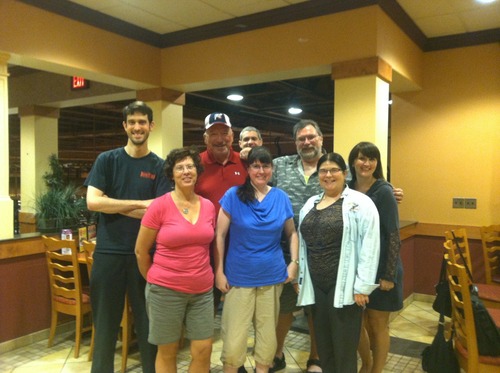
Last R&S Class

Last in-person class. Photo courtesy of Tiffany Schmidt


But the thing is, just like Luke Skywalker, we aren’t really losing Jonathan at all. Technology today has made it possible for us to continue this workshop virtually, through Skype. I am looking forward to keeping up the forward momentum we have built together. Although conversing with a flickering, pixelated mentor is a little too sci-fi even for me! But maybe we’ll get lucky and the Force will be with all of us.

I wish Jonathan all the best in his new adventures out in California. The man is a force of nature; I have no doubt he will do well. And I’m glad that technology will allow us to stay in touch as a class, because I get quite an energy boost from our meetings—and I think there are good things ahead for all of us. I want to be there to cheer the others on and celebrate when they get their big break. We’ve all done the hard work—but it’s with Jonathan’s guidance that we’ve come as far as we have.

So, thank you, Jonathan. It’s the end of an era—but the beginning of a new one. I can’t wait to see what new opportunities the new era brings.

Have you ever had a writing mentor?

GoosesQuill FB

My Dream Book Launch

I went to Jon McGoran‘s book launch for DRIFT Tuesday night, and that got me thinking about what I would like to do when I have a book of my own to launch.

Book launches come in all shapes and sizes, from small gatherings in a local bookstore to posh soirees in grand venues. Money is, of course, an object in planning a book launch, but there are many ways to cut costs and still have an unforgettable evening.

The main thing, I think, is to make a book launch special. It should be memorable in some way, and most times authors try to have a theme to their launch that reflects the book. You can reflect the book in the venue, utilizing a store or museum or school or other setting that features prominently in your book. You could choose a place that brings to mind themes of your book, such as a natural history museum for a book connected to nature or a historical society for a historical book.

The other way to reflect the book is in the giveaways you have and the decorations at the venue. A novel with the Greek gods in it might feature Greek decorations, for instance. A science fiction novel might have space-themed decorations. The swag will have the book’s title and probably the cover. Even the food can contribute to the theme, especially if food plays a role in the book or if you have an ethnic storyline in your book. Even if your book is about zombies, you can make zombie cupcakes. Let your creativity flow!

So what do I envision for my first book launch? Details will have to wait until I know what my first book will be, however, there are some basics I can share. First, it will be casual, informal. I am not a flashy person, nor a person who loves wearing dressy gowns and high heels, so I want a venue and atmosphere I can be comfortable in. There will be food and drink, of course, but the exact nature will depend on the book, the venue, and the time of day. I am also hoping to do some good with it, perhaps raising awareness of some issue or organization I feel strongly about.

Most important to me, though, it will be close to my home base. I want people to show up to my launch, so I want to have it somewhere that my friends and family can get to easily. I’ll need that support and camaraderie as I push my first book out into the world. Besides, all those people helped me get to the point of having a book published, and I want to share the day with them. My book launch will be as much to thank them as to herald the book.

So how about you? How do you envision your first book launch? If you have already launched a book or books, what would you want to do for your next book?

GoosesQuill FB

Newbery Picking

I decided as part of my continuing education in YA & children’s literature to read all the Newbery Award winners. The award has been given since 1922, so you can image the breadth of genre and writing styles encompassed by this list.

I’m nowhere near done the list, but I have been enjoying the adventure. I’m reading books I might not otherwise have picked up, and I can say that I have not been disappointed in any of them so far.

While I am enjoying them as a reader, I am also noting craft as a writer. I am always trying to improve my writing, so looking at how the best of the best wrote is a good education.

So far, three things have jumped out at me:

1)     In the Chronicle of Prydain series, Lloyd Alexander wowed me with his ability to have each character sound so unique that I didn’t need to read the dialogue tags to know who was speaking. This is something I struggle with—making them sound different and making the difference sound natural. I have not been captivated by a series so completely in a long time, and Alexander’s characterizations were a large part of my enthrallment.

2)     In Out of the Dust, Karen Hesse’s description of Dust Bowl Oklahoma blew me away. I could feel the dust smothering me, gritty in my eyes, mixed in my food. When I looked up from the book and out the window, the green grass and trees shocked me—I had almost expected dunes of dust. She wrote the novel in verse, so it is hardly surprising her descriptions are poetic, but I don’t think I have ever felt a novel so physically as this one. I have improved a lot in my description, but Hesse has set the new goalposts very high.

3)     Finally, all of the books could tell a story well. Obviously. But to read book after book where the structure is so solid and complete is a great way to “feel” structure. Some books had many action scenes and a breath-taking pace. Others not much “happened,” and the pace was leisurely (but never plodding). But with every book I feel confident and sure as a reader, safe in a skilled author’s hands, trusting them to lead me to a satisfying ending. And they all have. I believe my story-telling ability is strong, and although in my early drafts the beginning and end don’t always connect cleanly in the middle, I get there by the time I’m through.

This is homework I enjoy doing, and I look forward to learning much more from the remainder of the list.

What books have you read that stand out for you as stellar examples of some part of our craft? (I’ll add them to my reading list!)

GoosesQuill FB

My Biggest Takeaway: 2013 Philadelphia Writers’ Conference

This year was my third year going to the Philadelphia Writers’ Conference. I have always enjoyed it, and always been psyched up by the energy of the writing community there. This year, though, there was a vibrancy above the energy levels of the past years.

Perhaps this reflects a change in me, but I don’t think so—others noticed it, too. I can’t say why it felt different—perhaps it was the near-capacity crowd, perhaps the mix of teachers. All I know is that I was even more jazzed than usual.

A common theme seemed to emerge in the workshops I took this year: the theme of how to present yourself to the world as an author. Cecily Kellogg talked about bloggers and their voices. Suzanne Kuhn spoke about presenting yourself professionally and consistently online. Jonathan Maberry and Keith Strunk’s Act Like A Writer was all about the “writer-persona” you need to build to present to the world. Even in Solomon Jones’ Novel: Character workshop, we worked on our writer bio. Why? Because that bio is the first character we create as writers.

How to be a professional writer. How to be engaging online without giving too much information. How to be accessible without becoming vulnerable. How to be a public figure without losing our most private selves.

A common theme—but not my biggest takeaway.

My biggest takeaway goes back to the vibrant energy of this conference. Ever since my daughter was born, I have been in something of a creative funk. I have been writing consistently, blogging, have turned out a handful of short stories, but all my novel-length work has been on projects begun and first-drafted prior to my daughter’s birth. That never-ending rush of ideas that most writers have dried up after she was born, and I have been feeling totally uncreative for more than three years now.

But at the conference something stirred. Something sparked. A fleeting glimpse into a new character, a new plot. A siren song—still far off, but audible. My creativity raised its head and blinked sleepy eyes at the world.

I am by no means back to where I was creatively. But my creativity is not dead, as I had feared. It’s still there.

And it’s waking up.

What was your biggest takeaway from the conference?

GoosesQuill FB

What Message Are You Sending in Your Writing?

I have a three-year-old daughter, and that has made me very aware of the messages we send our girls in literature, movies, magazines, etc. Our culture sends messages that are at best annoying and at worst destructive, not just to girls but to boys as well.

So I read Karen Jensen’s blog post about messages we are sending our kids in YA with great interest. She noticed a trend in YA where 2 things happen: 1) a girl tells a boy firmly and repeatedly that she does NOT want a relationship (not sex, just a relationship) yet he does not take no for an answer and she ends up capitulating, and 2) in the final climax, it is the boy that saves the girl—the girl does not save herself.

I decided to look at my own YA work-in-progress (WIP) to see if I fell into those traps.

First, did any of my male protagonists ignore my female heroine’s “No” to a relationship (thus reinforcing the “no doesn’t mean no” culture)? To my relief, this was not the case. There is a boy who pursues a friendship with my heroine, even though Polly is hard to get to know, but she clearly WANTS to be friends with him and she communicates that.

Whew. One down.

Second, does my male companion end up saving the female heroine? That one’s a little harder. In the end, Polly does end up physically saving HIM, so at first it seems like another win for me, but… There is a moment, a key moment, in the climax where Polly needs to have an insight in order to save the situation. And the key insight is made by…the male companion. But is this a problem?

Every heroine has their sidekicks. Buffy had her Scooby Gang, and Harry had Hermione and Ron. All the sidekicks chimed in with important information—often key information—at times. In the end, though, in that climactic moment, it was always Buffy or Harry who stepped up and put it all together to save the day.

So is mine a case of a sidekick bringing valuable info that the heroine then acts on? It could be interpreted that way. And none of my beta readers have flagged that moment as not working.

But.

I am going to change it anyway.

Why? Because I think it is important to Polly’s character that SHE be the one to have the insight. She needs to have the moment of understanding and then wrestle with the new knowledge herself. This revelation she has fundamentally changes her perception of herself and her relationship with the world. It will be much more powerful for HER to realize this than to have someone else tell her.

So I thank Karen for her article, because even though I got it about ¾ right in my WIP, this will enable me to get it right all the way. I try very hard to think outside the cultural messages we’re all immersed in all day, every day, but it seems even I fall back onto those messages unconsciously. That is why it is so important that as a writer of YA and middle grade I take a step back and objectively look at the subconscious messages my books are sending. Not that I want to moralize or lecture—far from it. I just want to show my readers what kids can be.

I want to show them that their greatest strength lies in being true to who they are.

What about you? Do you ever think consciously about what messages your writing sends? At what stage in the process do you think about it?

GoosesQuill FB

Why I do things the “right” way

When I first started doing genealogy, I had no idea how to properly cite my sources. So I did it any old way. Now, I do know how to do it right, and I am engaged in a time-consuming process of going back over my source citations and correcting them. Since I’ve been doing genealogy for about 20 years, that’s a lot of source citations!

So why am I bothering? What I have is adequate, in that a person looking at it will know where my information came from. For example, I had a lot of entries from the Philadelphia City Directories. I noted the year of each directory, but not the page number. Good enough, right? I mean, someone else could easily look up the page number if they wanted to. Yes, they could. But it’s not the proper way to cite something. So I spent several hours re-finding the pages and entering them into the database.

Why, when what I had was good enough? In this case, it is because I want people who find my tree online or who read my book to take my work seriously. I want them to have the confidence that my sources are correct, that I am not guessing or engaging in wishful thinking (often an issue with amateur genealogists).

The same goes for my fiction writing (and everything I do, really). I can get to “good enough” in most aspects of the craft very easily. But “good enough” is not good enough for me. This is different from perfectionism, which is never satisfied and will never let go of a project that isn’t “perfect.” I know perfection is impossible, but I want to give my best effort on all levels at all times. I want to put everything I have into a project—cross all my t’s, dot all my i’s. Even when I don’t HAVE to.

Why? Because I am serious about my craft, and I want it to show. So I take the time to do the extra round of editing, to do the search and find on the “to be” verbs and “ly” words. I take the time to storyboard the book several times during the process, to make sure it all fits together and that I am not forgetting something. I take the time (and money) to have a professional editor give me feedback to make it stronger.

We all have experienced times in our lives when other people gave half-hearted effort and yet still got ahead—they got a better grade than you, they got a promotion, etc. We all know that doing things “right” is not a guarantee of success, or even a guarantee of acknowledgement. Sometimes I think my life would be much easier if I could be the type of person who settles for “good enough.”

So why do I bother trying to do things “right”?

Because at the end of the day, the product I put out reflects on me. Whether it be a book, a short story, a batch of cookies, a video, it is a product I created. I want to be able to take pride in the work, no matter if it gets me accolades or book deals. I want to know in my heart that this particular piece of work was done as well as I could do it at that time. That it reflects the best of me at that moment.

I suppose this strong work ethic was instilled in me by my parents (for which I thank them). But I have internalized it because of the satisfaction it brings me. Knowing that what I put out there is the best I can do is a rewarding experience for me. Another way to think about it: Most of us don’t leave much behind when we leave this earth—I want whatever I leave behind to be the best of me.

What drives you to put so much effort into your work?

GoosesQuill FB

WP-Backgrounds Lite by InoPlugs Web Design and Juwelier Schönmann 1010 Wien