


Mental Health Day

Sometimes with anxiety disorder, life gets on top of you. You’re just cruising along in your normal routine and then one or two new additions to your schedule crop up. These are not terribly taxing each in themselves, but the cumulative weight of everything starts to build.

You carry the weight because what choice do you have? Life needs what it needs. But the weight gets heavier every day, the exhaustion sets in, and eventually all you want to do is put it down.

Put. It. All. Down.

But if course you can’t put it all down, because life doesn’t stop, especially when you have a child. So you do the next best thing and put down the things you can.

So today I put down the blog, just for this week. I’ll be back next week!

Be kind to yourselves out there. If you need a break, find a way to give yourself one, even a small one. Put down what you can. You can always pick it back up when you’re ready.

Book Fair Spring 2019

It’s Book Fair time again! And this year it’s Dino-mite!
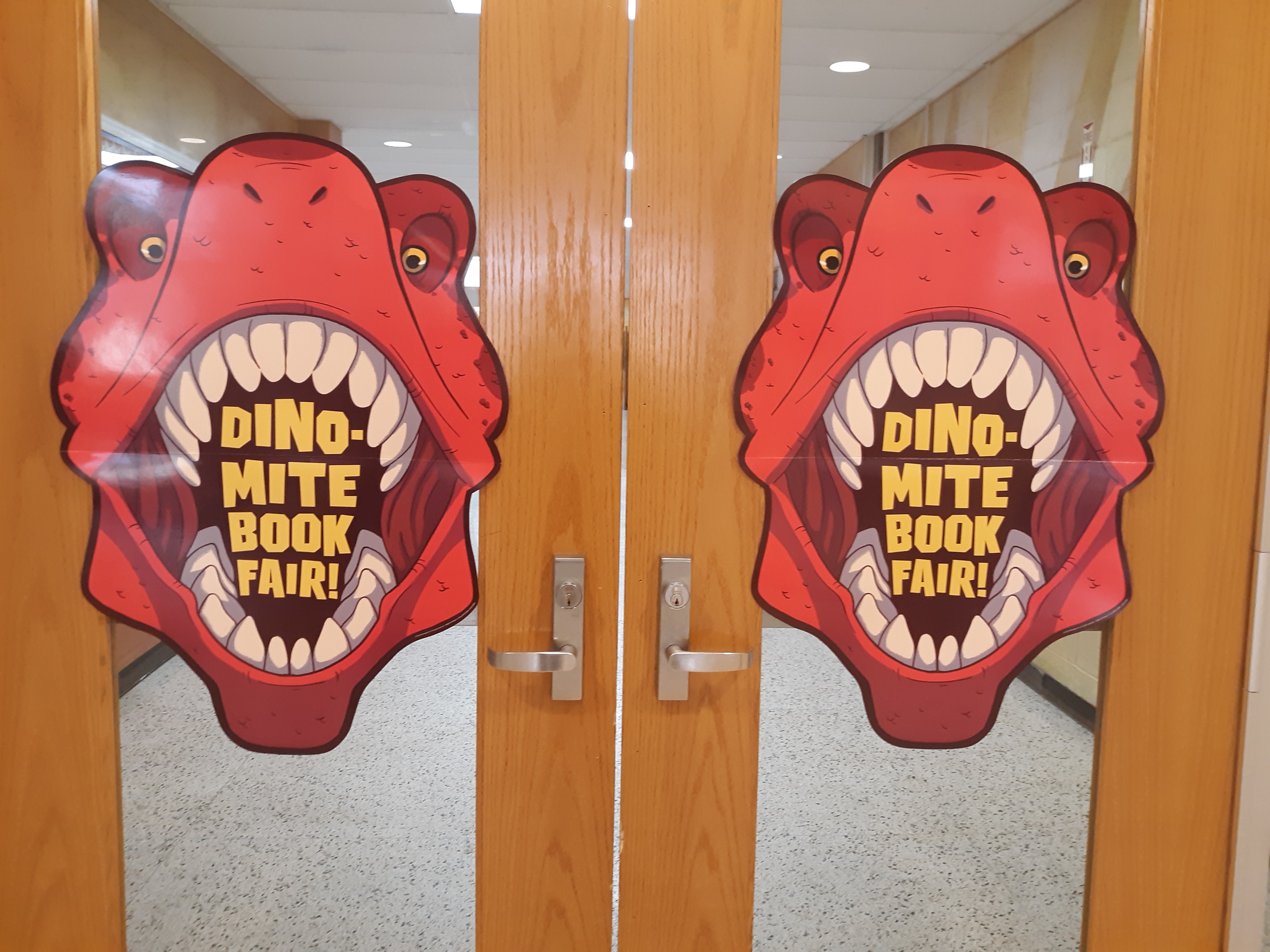
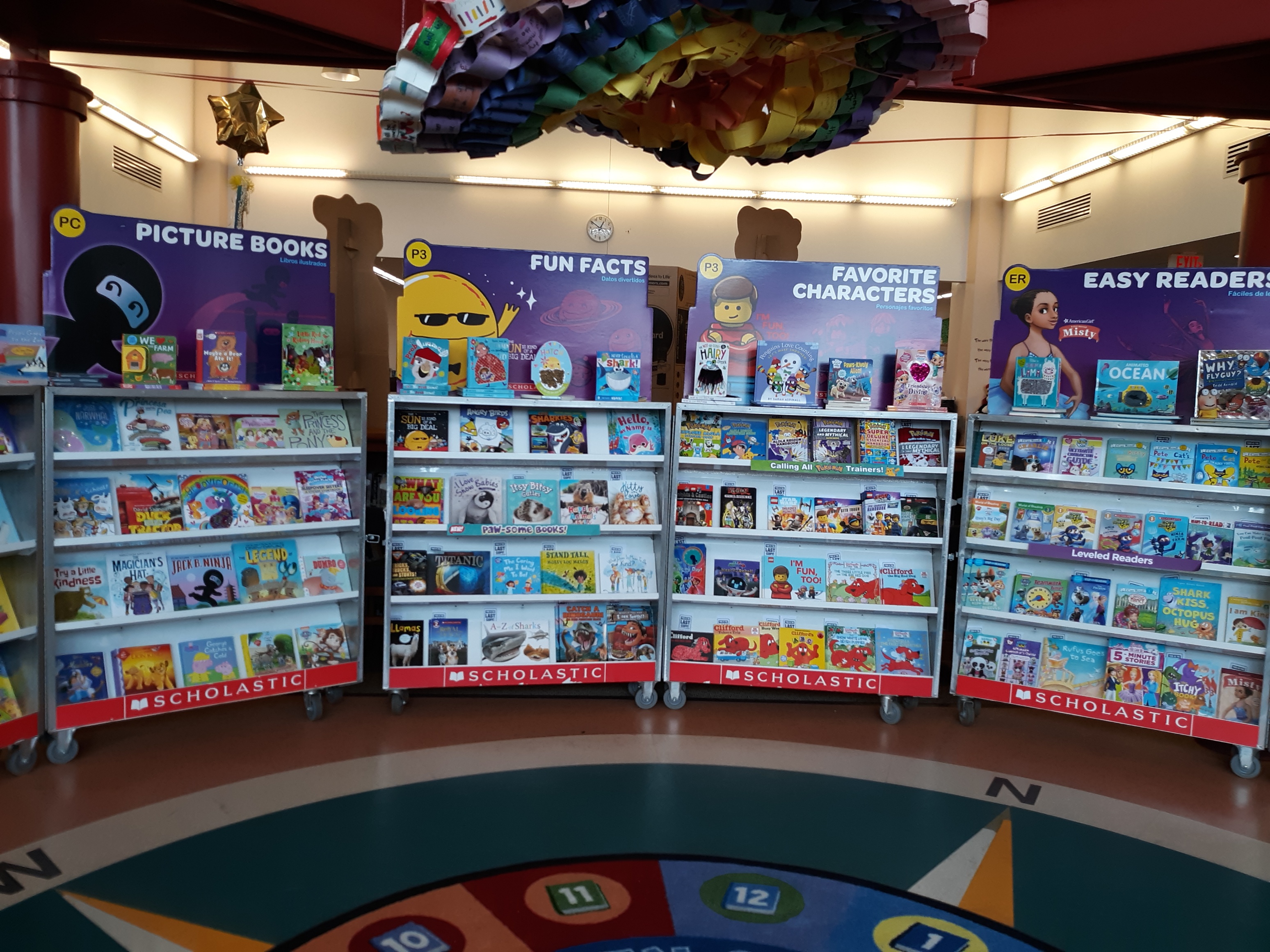
The first half of the Fair is usually the most hectic in my school. All the classes come in and browse the books so they know what they want when they return later in the week. The middle schoolers take care of themselves, but the younger grades make Wish Lists to take home for their parents to look at.

The Kindergarteners need lots of help with the Wish Lists, as many can’t read or write well yet. Some first graders need help, some don’t. Some just need help reading the titles that are in fancy or cursive fonts. Some kids need help finding the price on some books. And then there was the child who handed me a book and said, “Can you write this for me? The title is too long.”
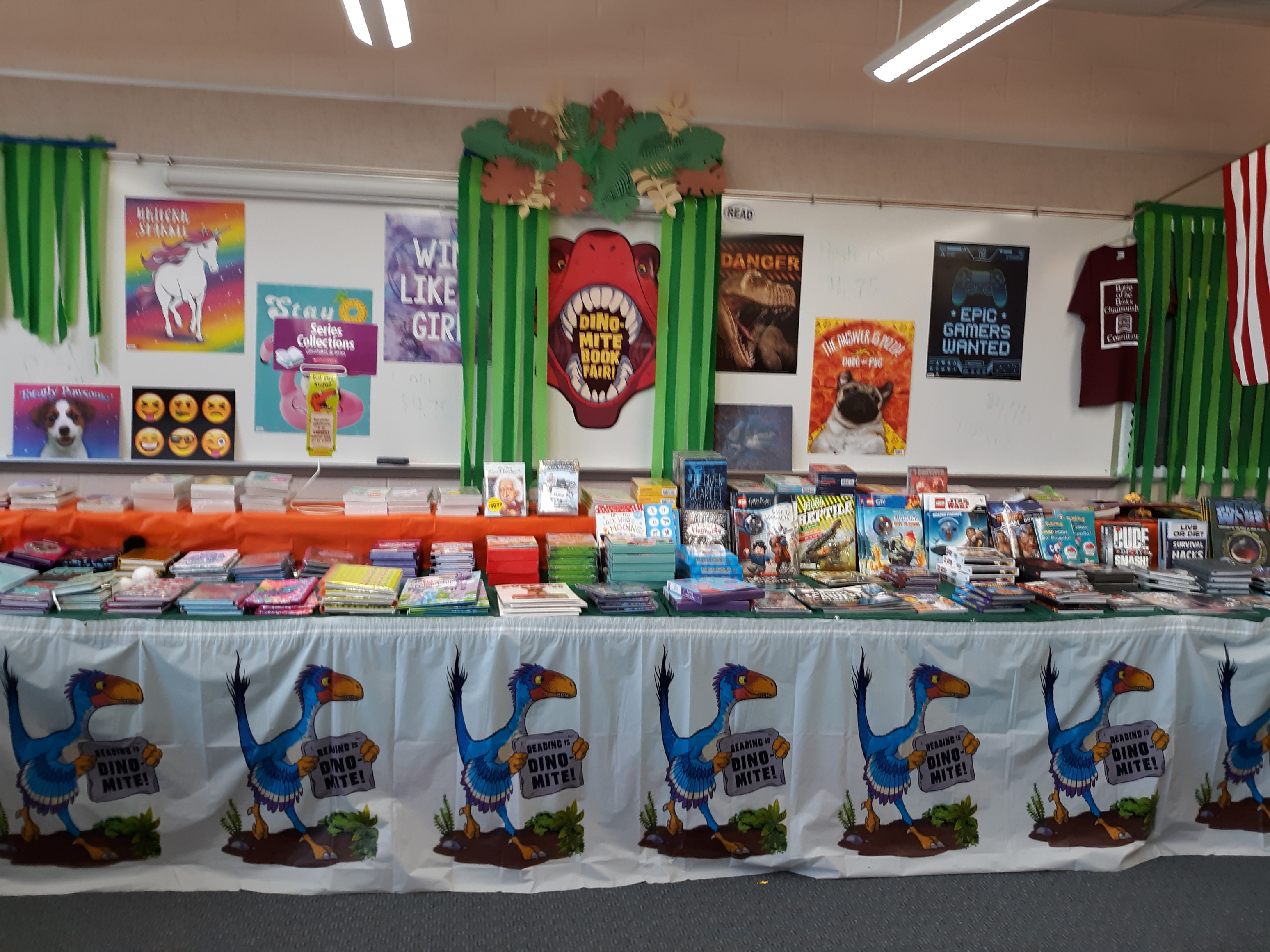
By 2nd grade most kids are able to do the lists themselves and we only have to make sure they are including all the necessary information. There’s also a shift in the lengths of the lists in 2nd grade. While the little kids would put every book the see on the list, the 2nd graders are more discerning. They know the type of books they like, and often will read the back cover blurbs before deciding if they want to put it on their list.

We’ve gotten through the most hectic part of the week, and now comes the fun part–seeing the kids’ faces light up when they buy their books and realize they can take them home to keep.

In our school all of the money made at the book fair funds the library, allowing them to buy new books, repair machines, and other library needs. It is the only funding for these items that they have, so the Book Fair is not only fun for the kids but plays a vital role in keeping the library fresh and interesting.
Separating the Art from the Artist

With the recent documentaries on R. Kelly and Michael Jackson, the perennial debate has resurfaced: when an artist does reprehensible things, what is the appropriate reaction to his art? Do we boycott, or can we indulge with a clear conscience?

This dilemma is not new. Roman Polanski, Woody Allen, Bill Cosby. Many of the greats have turned out to have feet of clay or worse. So where does that leave their art?

I have struggled with this, as have many people. In the end, when it comes to movies and TV and music, I have decided it is okay to enjoy the art despite the artist. These ventures are the product of multiple people’s efforts, and it seems unfair to punish all the others involved because of the actions of one.

Writers who have been called out for racism or misogyny are more problematic for me. A book is usually the work of a single person, and their worldview and biases almost always creep into their books. Names that come immediately to mind are H.P. Lovecraft, Orson Scott Card, and Laura Ingalls Wilder, all of whom have been subjects of controversy in the past few years. Lovecraft’s bust was removed as the statuette for the World Fantasy awards in 2015, Laura Ingalls Wilder’s name was removed from the Children’s Literature Legacy Award in 2018, and Orson Scott Card’s politics are acknowledged to be racist and homophobic. But where does that leave their works?

People are not black and white. We all are a mix of the ugly and the angel. Our society needs to stop with the either-or and realize it is “and”. These people did or said horrible things, AND they created art that moved us, touched us, became woven into the fabric of our lives. They were both beauty and beast.

Instead of jettisoning the beauty, we need to begin the difficult and painful task of contextualizing our celebrity heroes. Is it possible to condemn the actions, condemn the artist, while embracing the art? I believe it is. There is even a possibility that their lasting works of art grew out of the very damage that also caused them to behave in the ways they have—two sides of a coin.

Disgusting people can create beautiful art.

Brilliant artists can be awful human beings.

Evil people can do good things.

Their art can still teach us, touch us, and illuminate something deep about the human condition.

Art transcends time, space, and the artist themselves.

In the end, every consumer of art needs to draw their own line in the sand. That line will be different for each person. Predatory or bigoted behavior should absolutely be called out no matter who does it. But removing the good with the evil leaves the world a darker, bleaker place.

So my take is not to boycott the art, but to contextualize it, to teach the people coming to it for the first time where it came from. The artist’s actions will inevitably color the relationship of people to the art, as it should. This experience of placing the art in relation to the artist causes the viewer’s mind to wrestle with the deep complexity of human nature—which is exactly what art is supposed to do.

Three Benefits of Reading to Older Children

Pretty much from the minute she came out of my belly, my husband and I read to our daughter. All through the infant and toddler years, books were everywhere. My girl had 3 bookshelves full of books all to herself long before preschool. Now she is nine and a reading dynamo. She reads at a 7th grade level and has read over 300 books in each of the past 2 summers. So you’d think she doesn’t need us to read to her anymore, right?

Wrong.

Reading aloud to your child at any age is still a bonding experience. Sharing the story, living it together, is a joint adventure. It’s a memory you make. It’s also a good teaching tool. The vocabulary building is a major benefit. Teaching the child how to properly pronounce words they’ve only read is a secondary benefit. For example, teaching my daughter that “yacht” was not pronounced “yack-et.” Haven’t we all been there, wanting to use a word in conversation but not having any idea how it’s said?

Another good reason to read with your older child is because it sparks conversations about deeper issues. We talk about why people behave the way they do in the story. We discuss why people in the story feel the way they do, and maybe how she would feel in a similar situation. Sometimes it will open a conversation about something that happened to her at school. It is a good way for a child to explore confusing or intimidating social situations from the safety of their home and their parents’ arms.

But one of the main reasons I like reading aloud to my older child is a sneaky one. My daughter loves to read, but she is resistant to trying new authors or series. I have been trying to get her to read Misty of Chincoteague for months, because I was sure she would like it. No dice. So on our President’s Day holiday, she asked me to read to her and I brought out Misty. I read to her for an hour and a half (pretty near lost my voice). She kept interrupting with questions about what was going to happen, paid close attention to everything, exclaimed and reacted in all the right places. And once I stopped reading it (about 3/4 of the way through), she took it with her and finished it by the next morning. And now she’s reading the sequel, Stormy, Misty’s Foal.

Success.

This is not the first time I have read her into a new series. I did it with the Little House books, too. My daughter is an anxious child, she dislikes going out of her comfort zone. So me reading a new book or author to her allows her to feel safe while exploring new works—and more often than not she then jumps in with both feet. So reading aloud to your older child is a great way to pique their interest in new books, series, and authors.

I will gladly read aloud to my daughter until she no longer wants me to. And I will continue to read “with” her by reading books she has to read for school. I want the book conversations to continue. I want the shared experience to continue. I want the bond to continue.

And then, someday, perhaps she will read to me when my eyesight is failing, and the circle will be complete.


Considering a Social Media Break

First, Happy Valentine’s Day! Although I had many years where I had no romantic love on Valentine’s Day, I always looked at it as a day to celebrate everyone in my life who I loved–family and friends. Even though Valentine’s Day can make you feel lonely (been there), remembering that you are not really alone can help.

What doesn’t help when you are lonely on any holiday is social media. Seeing everyone else (appearing) to have a grand old time can hurt. So sometimes, when you know it will be a hard day for you, it might be a good idea to take a break from social media for that day. Be kind to yourself.

This thought, and this article by Roni Loren, made me think about taking my own break from social media. I really only spend time on one platform (Facebook), but I find I am spending an inordinate amount of time there lately. And it’s not useful time. I sometimes just find myself scrolling mindlessly down the feed, not even really registering what I am looking at. My problem is not so much that I check it obsessively, but that I can’t get off once I am on.

When I avoid getting on at all, I can be quite productive. And once I am involved in another project, I can effectively use social media as a reward. “Get X chapters done and then you can check your feed.” The trick is then getting off it in a reasonable amount of time. I only mean to be on for a few minutes, then suddenly I have lost hours to it!

So I am thinking of taking a break. Not completely. I would keep my blog up, for instance. My email is not a problem, as I get relatively few that need attention. It’s the social media. The purposely addictive nature of it sucks me in, and I feel like the constant bombardment of information is weakening my concentration skills. I used to be able to write for hours, now after 20 minutes I find my mind wandering.

There are some non-social reasons for me to be on Facebook, so I think a complete walkaway for more than a day or two is unrealistic. But hopefully I can confine my getting on to a couple of times a day, for about 15 minutes each. I’ll set a timer. I hope that doing so will “detox” my brain a bit an let me refocus on focusing.

I’m not sure when or for how long I will try this, but I think it has to happen at some point.

Have any of you taken social media breaks? How did it work out for you?

Writing Chiropractic: Making Adjustments to Your Flow

I see a chiropractor every couple of weeks. I admit to being skeptical at first, but thought I would try it. While he has not been able to fix everything on me, his adjustments have eliminated ling-standing hip pain, lessened both the frequency and length of chronic headaches, and gave me almost instant relief from excruciating hip pain from an injury. So adjustments have helped me immensely.

The basic premise of chiropractic care is to keep our spines aligned to allow for proper signal flow along the nerves. Misalignment in the spine (and elsewhere) can block the flow, causing pain or other malfunctions. So an adjustment will remove blockages and allow for proper body functioning.

We need to make such adjustments to our writing process from time to time, as well. Our writing process isn’t stagnant, and as we evolve as writers we need to adjust it. Our stories become more complex, the demands of our daily lives change, and what worked before may no longer work now. So we need to take a step back and look at our process, and see where we can remove blockages to get our productivity flowing again.

On a project level, we need to do the same with our stories. Does the flow work? The pacing, the character arc, the plot, must all flow together. If any one if those elements (or others like word-level rhythm) is blocked, the story doesn’t work smoothly and the reader loses interest. Revision provides us with the opportunity to make adjustments that make our prose glow.

Obviously there is no such thing as a writing chiropractor. So where do we go to find someone who can help us make the necessary adjustments? We can hire editors, use beta readers, critique groups, or critique partners. The feedback from any of these people can help us remove the blockages that are keeping our story from flowing properly.

Beating Imposter Syndrome: Don’t let it hold you back

While preparing this week’s Top Picks Thursday blog post for The Author Chronicles site, I read Joan Stewart’s blog post 9 inexpensive revenue streams for broke or struggling authors. One of her ideas was to write “special reports” that you then sell individually. That sounded like a good idea, and I started playing with ideas of what topics to consider. And then it struck: the dreaded Imposter Syndrome.

Every topic I thought of, I wondered what gave me the right to think I could speak authoritatively on that topic. There were certainly other people out there who knew more about it than I did. People who are true experts in that topic—and topic—every topic. Who did I think I was?

This is how Imposter Syndrome holds us back. By making us believe we are not good enough, don’t know enough, don’t have the right credentials. By making us feel this way, Imposter Syndrome robs us of our voice, causes us to pass up opportunities, and makes us doubt our value.

There will always be someone who knows more than you, who is more of an expert. But that does not mean you can’t bring value to the discussion. Perhaps your information is available and accessible in a way the expert information is not. Perhaps your information approaches the topic from a different angle than is usually presented. Perhaps you synthesize two viewpoints not normally seen side-by-side. Perhaps you simply have such a passion for the topic that you want to share it with everyone.

Your interest in the topic will be unique simply because you are unique. In much the same way that a story you write will never be the same as anyone else’s, even if the premises are the same, your take on the topic will be different than anyone else’s. So don’t feel like an imposter. As Darren Rowse reminds us, you can write on a topic without being an expert.

So don’t let Imposter Syndrome paralyze you. Write about topics you love. Explore them and take your readers along with you. And the more you write on the topic, the more expert you will become. Soon you will be an imposter no more!

Has Imposter Syndrome ever gotten in the way of your life? How did you overcome it?

A Muddy Revision Slog

I am finally getting back to writing. Not drafting right now, but revising something I have been putting off. Sometimes revision is clear and straightforward. In fact, I usually prefer revising to drafting. But this time the revisions are difficult—muddy.

In theory, I know what to do. Among other things, I am shoring up the “goals” in my protagonist’s scenes. Making clear what she wants. Because the feedback I got was that her goal got muddy after the first few chapters and therefore the reader lost interest in all the confusion.

So I have sharpened in my mind the overall story goal—the one that drove her from the beginning. But I am having trouble bringing that goal to the surface in all the scenes, because sometimes the scene goal necessarily overshadows the book goal. When you’ve been imprisoned and tortured, the immediate goals of survival and escape take precedence over all else. So maybe I have the wrong story goal altogether and that’s why I’m having so much trouble with it. And sometimes what the character thinks they want and what they actually need are not the same. And sometimes what they want changes over time. So I’m slogging along but not sure I’m making the story any better—I may be muddying it further.

The second part of the revision is my struggle with the Points of View (POV). I have 3 POV characters—but have been told that I should lose two of them. One is the villain (an adult), and the advice I got is that adult POVs have no place in YA. Unfortunately for me, I love this villain and find her very interesting, so it’s killing me to lose her POV. I also need to find a way to get some info that only that character knows into the story so the reader can know it, too.

I disagree with losing the second POV, as it is the twin brother of the main character. The genre is also space opera, which by its nature has a large canvas and usually needs more than one POV to tell the complete story. So I am trying to tie his POV closer to the main character’s to make his POV more relevant, as well as trying to find other ways to tell his part of the story that may involve the main character.

Again, not sure if I am helping or muddying at this point.

I’ll just push through the mud and then take a look at the finished whole and see what I think. I’m not totally happy with the way the revisions are going, but that doesn’t necessarily mean they’re not actually going well. It’s just that right now there’s so much mud I can’t find the solid ground underneath.

So, fellow scribes, how do you know if your revision is making your story better or worse?

New Year, New Goals

Everyone posts New Year’s resolutions. I don’t so much do resolutions as goals. And I would like to try and make them realistic goals, so I don’t frustrate myself. The uber-healthy diet and sculpted beach-body? Not gonna happen. I’m going to try something more amenable to my couch-potato self.

I have talked about being in the midst of a great burnout. No creativity at all. 2018 was horrific, writing-wise. I totaled 89,672 words—and 73,218 of them were blog or other non-fiction writing words. Compare that to 2017, when my total words were 405,116, with 326,542 of those being fiction, and you can see how badly I fell off the workhorse.

So what am I aiming for this year? I have no specific word count in mind, but I do have two goals I want to reach:

  1. Finish revising Veritas.
  2. Re-release The Witch of Zal with new cover and illustrations.

Both are doable. I intend to do them.

Over this holiday, I have been trying to sleep more, to get out of the spiral of exhaustion and anxiety that I’ve been in for months. I think it is helping. I have an interest in getting back to revising Veritas, which I have been avoiding for quite some time. There’s a new angle I want to lay into the existing framework that intrigues me–and scares me, as I am not certain I can pull it off. But I want to try, which is  huge step forward.

So that’s my master plan for 2019. Not Earth-shattering, for sure. But within my reach. The burnout took a long time to set in fully, it make take some time to climb my way out of it. But I pledge to be kind to myself, to try and focus on taking better care of myself, and hopefully get back on that writing workhorse again.

What goals have you set for yourself this year?

The Best of The Goose’s Quill 2018

I always enjoy looking back over the past year and seeing what posts readers enjoyed most. I see an unexpected pattern with the top 4. Enjoy!

10. Genetic Genealogy: Proving the Paper Trail

9. Anxiety Spiral: Idling in “A” Gear

8. Control Your Inner Critic: The Power of a Name

7. Power Outage 2018

6. The Split Brain Phenomenon: On the Outside Looking In

5. On Being a Low-Energy Person in a High-Energy World

4. Spring Book Fair 2018: Snowmaggedon!

3. The Enchanted Book Fair: Fall 2018

2. 48 Years

1. Book Fair Magic: Casting a Reading Spell

Thank you to everyone who has read The Goose’s Quill this year! I hope you all have a safe healthy, happy 2019!

WP-Backgrounds Lite by InoPlugs Web Design and Juwelier Schönmann 1010 Wien